

Latest Stake.us Promo Codes
| Stake.us Product | Stake.us Code | Bonus Offer |
|---|---|---|
| Stake.us Sign-up Bonus | HELLAUSA | Get 260,000 GC + 55 SC + 3.5% rakeback |
| Stake.us No Deposit Bonus | HELLA200 | Get 260,000 GC + 55 SC + 3.5% rakeback |
| Stake.us Bonus Drop Code | HELLANEW | Get 250,000 GC + 25 SC |
What Is Stake.us and How Does It Work?
Stake.us is a legal online sweepstakes casino dedicated to players residing in the United States. Contrary to other online casinos that only accept real money play, Stake.us is unique as it offers two playing modes.
With the sweepstakes model, players can play for real, meaning that a unique currency which is used for this mode has monetary value. Stake Cash is used for real play. Keep in mind that 1 Stake Cash = $1.
On the other hand, players can use Stake.us as a social casino too. This means that they can play without any pressure or necessity to make a deposit on the platform. For this type of play, Gold Coins are used. Gold Coins do not hold monetary value and they can be earned in different ways. For example, players can redeem a Stake US bonus code and get their hands on free Gold Coins.
Prize redemption on Stake.us when using real money is a bit different compared to typical online casinos. Players can redeem their winnings for real prizes through cryptocurrencies. Alternatively, gift cards from various vendors can be used to receive winnings too. The process is quick, safe, and reliable. Despite not being a traditional online gambling site, Stake.us ticks all the right boxes in terms of payments and game availability.

How to Use a Stake.us Promo Code
Using a Stake.us promo code is a simple process. It does not matter if you are an experienced veteran or a total beginner, you will easily redeem the code and claim rewards. To give you a helping hand, we have compiled a detailed step-by-step guide that will get you started on the right foot. Here are the details:
- Visit the official Stake.us site: With the initial step, players need to visit the official Stake.us website. To stay on the right track and avoid any form of phishing attempt, it is recommended to visit the platform by clicking on a trusted referral link.
- Create an account: Upon visiting the official website, look for the sign up button. The button is located in the top right corner of the website. By clicking on it, a new pop up window appears containing a registration form.
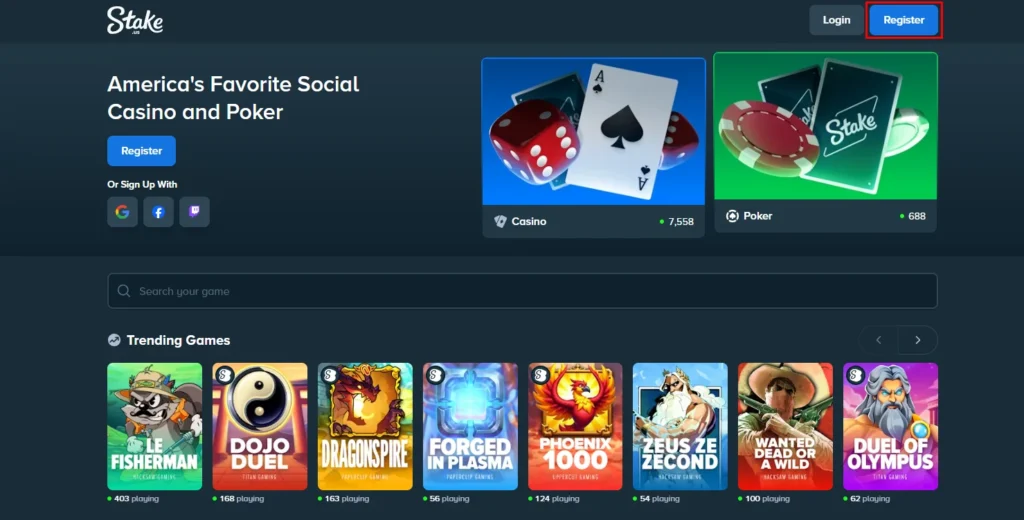
- Enter the promo code in the designated field: Once the registration form is filled out, new users need to click on the text “Referral Code (Optional)”. This will open a new text field where the Stake US promo code can be entered.
- Verify your email and identity: At this point, the account is successfully created. It is time to verify the information you provided. To begin with, players must verify the email or phone number they provided. Afterward, identity needs to be confirmed too. This is done by completing the KYC (Know Your Customer) account verification. It will only take a couple of minutes.
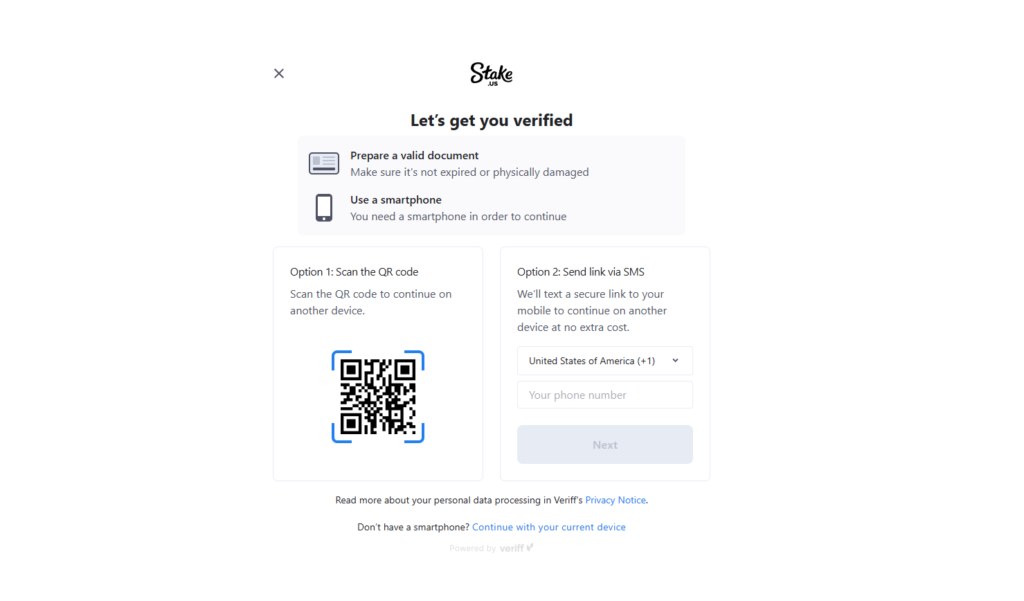
- Start playing and collect Gold Coins or Stake Cash: By completing all the necessary steps we described, you can start using Gold Coins and Stake Cash to play your favorite games on the website.
Promo codes provide an exceptional way for beginners to get their gambling campaign started on the right foot. By redeeming the best Stake US bonus, newcomers will get their hands on free coins or claim access to additional exclusive deals on the platform.
Types of Bonuses Available on Stake.us
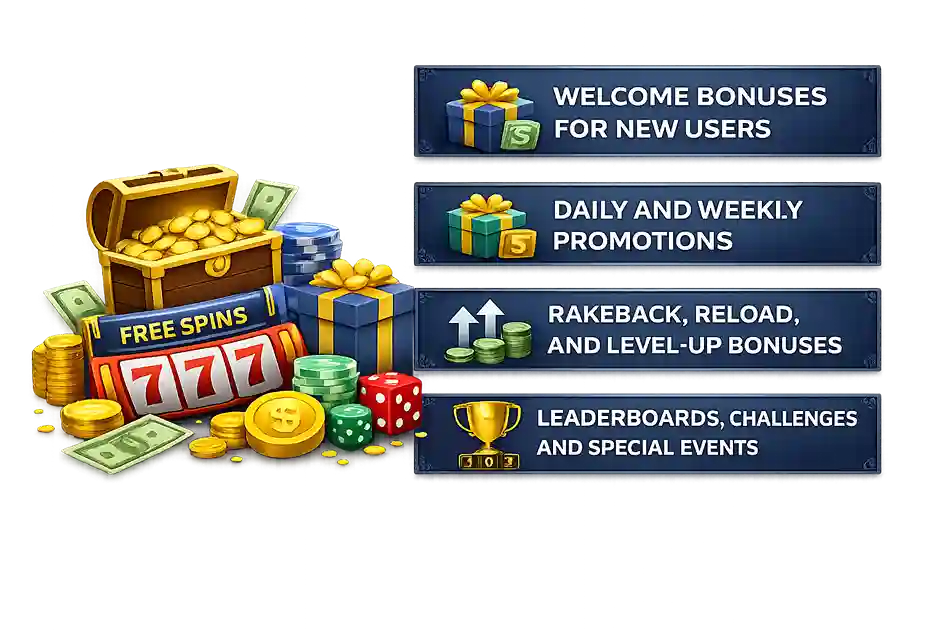
Stake.us offers both loyal players and new ones with a stunning range of bonuses and promotions dedicated to rewarding them for every wager they place on the site. Offers below have nothing to do with making constant deposits to claim rewards. With that being said, here are the deals you should not miss out on.
Welcome Bonuses for New Users
The show on the site starts once the Stake.us promo code is redeemed. With this offer, players can get a head start as they will receive both Gold Coins and Stake Cash for free. We can confirm that the received funds can be used across the board. This means that players can test their luck across all available games on Stake.us.
Daily and Weekly Promotions
If you did not know by now, Stake.us likes rewarding loyal players. Rewards can be claimed every 24 hours or once a week. With these promotions, it is possible to receive both Gold Coins and Stake Cash without having to make a deposit.
For example, Stake.us will reward players who frequently visit the website. Just by logging in to your account every day and visiting the “Wallet” section on the website, you can receive a small amount of Stake Cash and Gold Coins for free.
Rakeback, Reload, and Level-Up Bonuses
Three main bonuses on Stake.us revolve around placing wagers and getting rewarded for that. Let us put things into perspective. With the rakeback offer, players are receiving a part of the house edge back on every eligible wager placed on the website.
With the reload offer, Stake.us will cover a part of your overall losses during the week. Take note that the reload offer can be claimed once every seven days, while the rakeback can be collected instantly.
Last but not least, Stake.us is taking care of loyal players in multiple ways. One of the most generous bonuses is the level-up one. Once a player reaches a new tier in the VIP Club, he will receive an exclusive reward consisting of a large amount of free money. Take note that the higher the level you reach, the better the rewards will become.
Leaderboards, Challenges, and Special Events
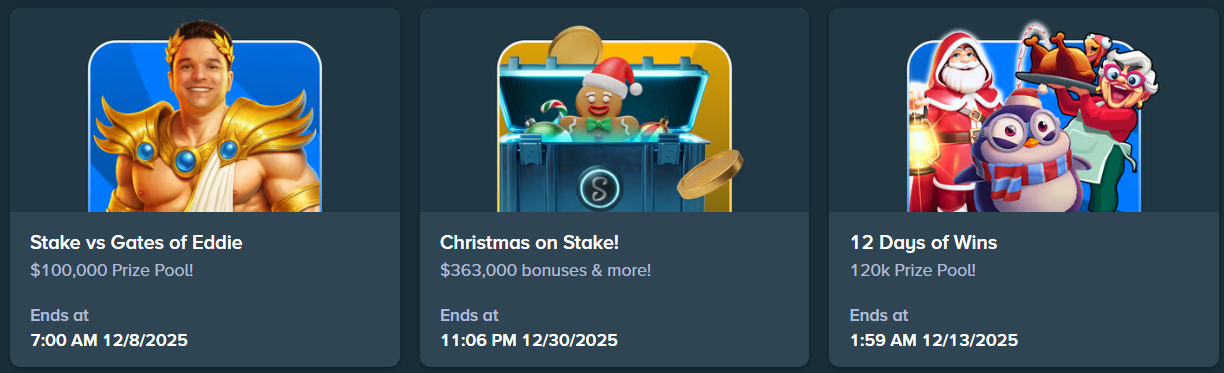
To make things even more competitive, Stake.us regularly hosts daily and weekly leaderboards, giving all players on the site a fighting chance of winning extra money. Every day, 50,000,000 Gold Coins can be won by players who wager the most on the site. On top of that, a stunning 25,000 Stake Cash is handed to lucky players every week through the weekly raffle.
If you like to compete for a chance to win extra money on the site, Challenges might be the perfect promotion for you. Here, you are required to hit the target multiplier. By doing so, you will get your hands on impressive rewards including both Stake Cash and Gold Coins.
Last but not least, Stake.us teamed up with the most popular developers across the world. This led to exclusive deals and impressive rewards which are handed out to players who complete the necessary tasks at hand.
How Stake.us Coins Work: Gold Coins vs. Stake Cash
Stake.us operates on a two-currency system that disconnects free play from winning play. Gold Coins are used for social gaming and do not have any real-world value, whereas Stake Cash is the sweepstakes currency that can be exchanged for crypto or gift cards on fulfilling the minimum requirements. It’s important to understand the difference before using a Stake.us promo code as most bonuses come in both currencies, but you can only cash out one of them.
| Feature | Stake Cash (SC) | Gold Coins (GC) |
|---|---|---|
| Real monetary value | ✅ Yes — 1 SC ≈ $1 | ❌ No value |
| Can be redeemed for prizes | ✅ Yes (crypto or gift cards) | ❌ No |
| Main purpose | Sweepstakes / prize play | Free social play |
| How you get it | Bonuses, promos, GC purchases (as a reward) | Free rewards or purchased bundles |
| Can you buy it directly | ❌ No | ✅ Yes |
| VIP progress contribution | High | Low |
| Wagering impact | Counts fully toward rewards | Minimal impact |
Gold Coins are ideal to test games with no risk, whereas Stake Cash is necessary if you want to play for real rewards. Most play GC to practice and hold SC for bonus play and redemption.
How We Evaluate Stake.us Promotions
It is important to properly evaluate Stake.us promotions. By doing so successfully, we can provide players with important insights into the bonus requirements and whether the offer is transparent. To find out our evaluation process, refer to the list below:
✅ Fairness and transparent promotions: The most important evaluation revolves around transparency. All requirements, terms, and conditions must be clearly disclosed in the bonus letter. Of course, all promotions should be fair. If there is a leaderboard attached, it must be publicly available for all players to get insight into the current rankings.
✅ Playthrough requirements and account eligibility: It is important for promotions to offer playthrough requirements which can be realistically met. For example, if you need to play through bonus money 50x before payout can be made, then players need to understand that fulfilling such a criteria is next to impossible. We take into account the account eligibility as well. Promotions should be unlocked for majority of players, not just the selected few.
✅ Variety and frequency of bonuses: Social and sweepstakes casinos can’t be just about the welcome bonus offer. These platforms must provide players with a decent variety and frequency of promotions. Of course, offers should be easily accessible without having to fulfill insane requirements just to participate.
✅ Ease of claiming rewards: A lot of players experienced how hard it can be for them to claim bonus rewards. Some platforms will require up to 7 days to release the payment, which is ludicrous. We can confirm that this is not the case with Stake.us. Claiming the rewards is easy and simple. Usually, it takes the site up to 24 hours to release the bonus payments.
✅ Player satisfaction based on public community feedback: Players talk a lot online. We take into account each player’s satisfaction based on the promotion he used. With such an insight, we can get a clear picture of whether the bonus or promotion is trustworthy or not.
Stake.us Games Overview
Stake.us offers a diversified range of online casino games. In all fairness, there is something for everyone on the platform. If you are a fan of classics, Stake US has you covered. On the other hand, if you want to play exclusive titles with modern graphics, you can do so too. Here is a brief overview of the available games:
- Slot games: By far the most popular section on Stake.us revolves around slot games. Here, players can enjoy a stunning range of various slots developed by popular vendors. On the site, you can enjoy games developed by Pragmatic Play, Hacksaw Gaming, NetEnt, Microgaming, and many more. Alongside slots, gamblers can enjoy progressive jackpots and bonus buys.
- Table games: A lot of table games can be played on Stake.us. The most popular titles revolve around Blackjack, Roulette, and Baccarat. We can confirm that Stake has its own edition of Poker which can be played against the house.
- Live Casino with real dealers: Another notable game category revolves around table games with live dealers. Instead of playing with pace against the house, you can do the same thing, but this time around, with real dealers. Dealers are professional, polite, and friendly. The majority of live casino games with real dealers on Stake.us are developed by Pragmatic Play and Microgaming.
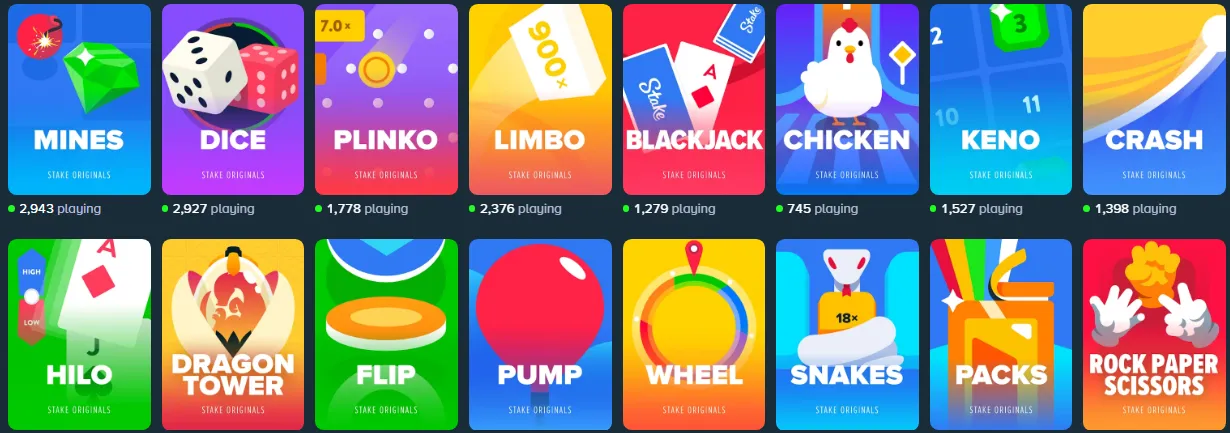
- Stake originals: Last but not least, Stake US has developed its own range of Original games. In this category, players can enjoy popular options like Crash, Dice, Plinko, and Mines, rest assured knowing that Stake.us has you covered.
As it can be seen from the list above, Stake.US offers a stunning range of games to choose from. Take into account the fact that every game on Stake.us is covered through a dedicated provably fair system which ensures that the outcomes are random and can’t be tampered with. Finally, we can confirm that the gameplay is smooth no matter the device you are using. All games are accessible on both desktop and mobile devices.
Mobile & Desktop Experience
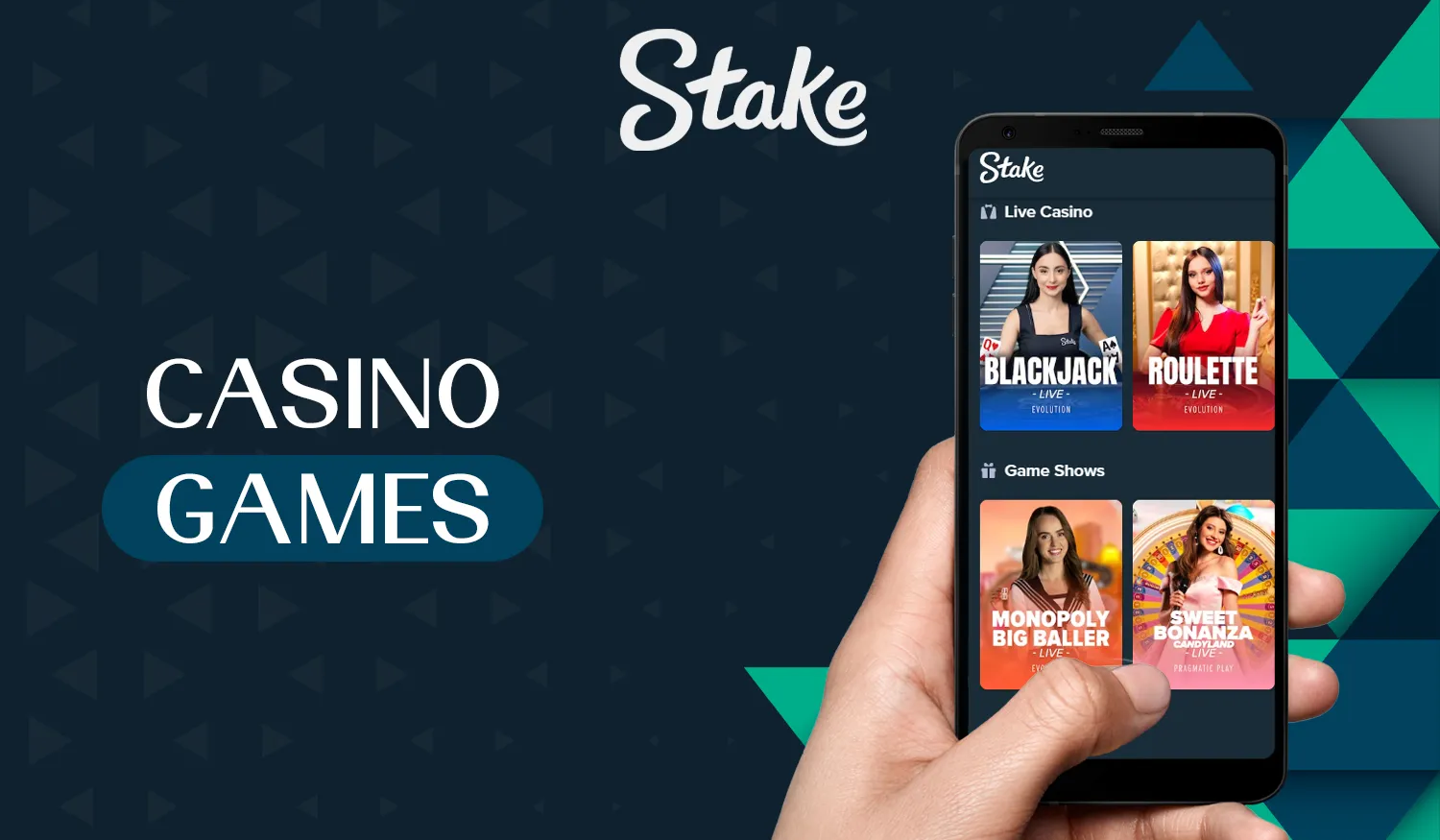
Stake.US offers a pristine gambling experience no matter the device you are using. Design is responsive and user-friendly. Everything of importance is located just a few clicks away. In our experience, the site is developed through an intuitive layout ensuring that even complete beginners can find their footing without breaking a sweat.
If you are using Stake.US on your mobile device, you can access the site in two ways. First and foremost, the site is compatible with the latest mobile browsers such as Chrome, Firefox, Edge, and others. Alternatively, iOS mobile device users can download the official Stake US mobile app through the official App Store.
Keep in mind that gameplay, bonuses, and Stake US promo code redemption remain unaffected no matter if you are playing on the site through a mobile browser, an official app, or desktop.
Safety, Fairness & Legality of Stake.us
If you are having doubts about the legality, safety, and fairness of the Stake.us social casino, make sure to go over this section. In this one, we will uncover the most important information that will shine a light on how Stake.us is operating legally and how good the security and fairness standards on the website are.
Because Stake.us does not offer real-money gambling (which is the basic definition of a sweepstakes casino), they can operate in different states. With that being said, players must be aware of the fact that Stake US is not licensed or regulated by a governing body or a commission. However, this should not be seen as a problem due to the stellar reputation Stake upholds.
Fairness plays a vital role on Stake US. As you are playing the majority of the games around the house, players need to be reassured that all game outcomes on the site are randomized and that no one can tamper with the outcomes. For that reason, a dedicated provably fair system is operational. With it, players can confirm the round result as soon as it is finished.
All sensitive information you disclose on Stake.us is safely secured. This is achieved through the HTTPS protocol and SSL encryption. With these security tools, financial and personal information broadcast over the network remains secure and out of reach for potential hackers. Additionally, players can enable 2FA (two-factor authentication) to secure their accounts even better.
Stake.us is doing a lot for the community. This can be seen through the promotion of the best responsible gaming practices where they provide tips and advice that will help gamblers stay in control. We have verified the website security and it aligns with the research and player feedback received.
Responsible Social Gaming at Stake.us
Top sweepstakes casinos will put a lot of emphasis on promoting responsible social gaming practices. Stake.us is heavily involved in this topic. This is evident from a wide range of safety tools and features that provide players with additional control over their actions. Some of the most available tools revolve around:
- Daily limits: If you did not know by now, Stake.us provides players with a chance to put in place daily limits regarding deposits or wagers. By doing so, customers can stay in control of their spending limits and total placed wagers.
- Break-in-play tools: With this helpful tool, players are forced to take a break. Keep in mind that this process is not automated. Gamblers need to willingly choose how long they want the cooling period to last.
- Self-exclusion requests: If you believe that you are on the edge, you can always take advantage of the self-exclusion request. This can be handled by reaching out to the customer support which will process the request right away. Alongside temporary exclusion, players can exclude themselves from playing on Stake.us permanently.
- Links to responsible gaming organizations: As you can see, Stake is doing a lot to promote responsible gaming to players. Alongside the tools that are enforced on the site, gamers will find links leading to responsible gaming organizations that will help you tackle addiction on the spot and without any cost.
Payment and Redemption Methods
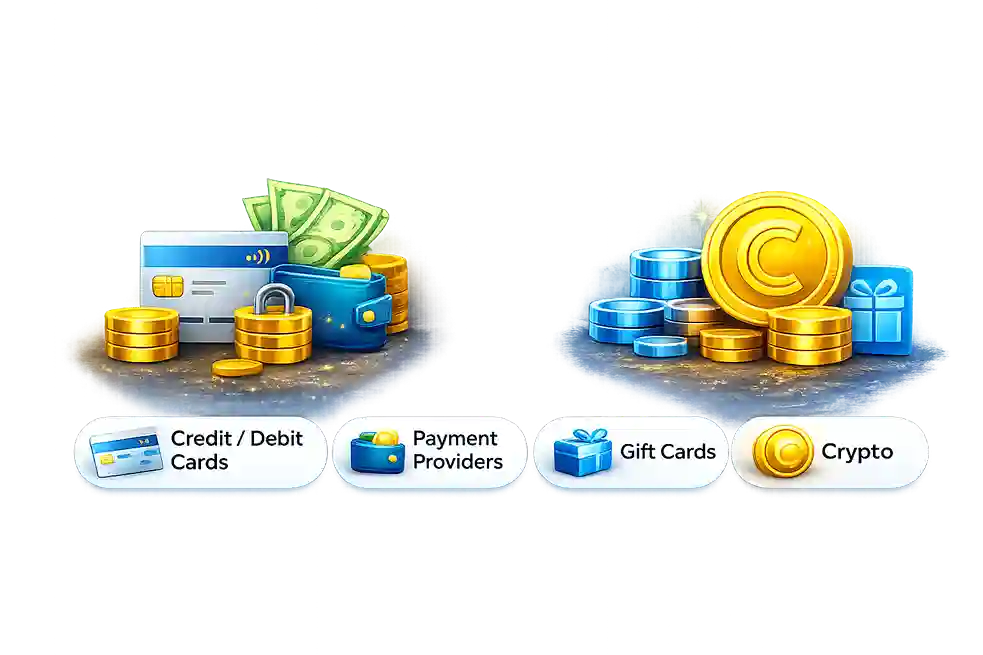
Deposits and withdrawal options on Stake.us are straightforward. As described above, Gold Coins can’t be withdrawn from the platform while players can exchange Stake Cash for either cryptocurrencies or gift cards.
Deposit methods vary from traditional credit card top ups to cryptocurrencies, and bank transfers. We can confirm that credit cards and crypto payments are processed in real time. When funding the account, players are purchasing Gold Coins. As a reward for making a purchase, Stake Cash is assigned to the bundle too.
Given the fact that Stake Cash is the sweepstakes currency used on the site which means it holds monetary value, players can redeem it for various rewards. However, to make a payout, players need to fulfill the basic requirements such as completing the account verification steps (KYC) and meeting the minimum withdrawal limit.
Based on our experience, payouts on Stake.us are instant. It does not matter if you are withdrawing cryptocurrencies or gift cards from popular vendors like Walmart, everything works like a charm.
Crypto payouts are much easier as you only need to provide a valid crypto wallet where the funds will be sent. On the other hand, when collecting gift cards, you need to disclose an email where a digital gift card will be sent. All in all, Stake.us offers transparent and straightforward options to fund the account and to collect your winnings.
Stake.us VIP and Loyalty System
Active players get rewarded further with extra bonuses and higher rakeback rates as they level up through the Stake.us VIP tiers. Progression is gameplay-based and each new tier grants additional Gold Coins, Stake Cash and better weekly rewards. More benefit is available at higher levels, and all VIP rewards are transparent and easy to track in your account.
| VIP Feature | Details |
|---|---|
| Levels | 6 main levels with sub-tiers |
| Level-up rewards | Free Gold Coins + Stake Cash |
| Rakeback | Increases with higher tiers |
| Reload bonuses | Improved weekly reloads |
| Monthly rewards | Available at higher levels |
| Wagering requirement on VIP rewards | ❌ No rollover on free VIP funds |
| Progress tracking | Visible inside the account |
| How to level up | Play with GC and SC (SC counts more) |
The system is pitched at the regular player, the more you play the more rewards you unlock so the more tiers you advance, the better the rakeback and the bigger the bonus drops.
Stake.us vs. Other Sweepstakes Casinos
Stake.us was not the only sweepstakes casino we tested. However, this platform stands out in the crowd due to various factors. In this section, we will provide players with an overview of the most important factors, showing you why Stake.us stands out.
- Better promotions: First and foremost, Stake.us stands out due to better bonuses and promotions. Loyal players on the site can claim constant rewards just by staying active. To make things even better, such rewards often come without any requirements attached, meaning the prizes can be cashed out without much hassle.
- Clean and smooth UX: In our opinion, Stake.us offers a fantastic website that runs smoothly and is fast. Everything of importance is just a few clicks or touches away ensuring the best possible user experience.
- Impressive range of games: More often than not, social casinos and sweepstakes tend to offer a limited range of gambling options to choose from. That is not the case with Stake US. Customers will enjoy a wide range of titles including slots, game shows, table games with live dealers, and Stake Originals.
- Exceptional community: At this point, Stake became an outright brand for online gambling services both in the United States and worldwide. This allowed Stake to build a great community and let the players connect in different ways. Forums, Telegram channels, and live chat are up and running to promote the community and help players bond.
Tips for Maximizing Your Stake.us Experience
Based on our expert take and hands-on experience with the Stake.us platform, we want to provide beginners and players looking to improve their experience with an ultimate list of tips. Here is what not to miss out on:
✅ Log in every day to claim free rewards: Stake.us provides all players with an active account with free rewards. By logging in every day and visiting the “Wallet” section, you can claim 1 Stake Cash and 10,000 Gold Coins for free and without a deposit required.
✅ Take part in challenges and tournaments: To get the best possible experience when playing, make sure to opt in for various challenges or participate in tournaments. By doing so, you can get your hands on additional rewards just by playing different games. You will connect with the community too.
✅ Test various games on the site: Never stick with a single game on Stake.us. The library is impressive and you will find numerous interesting titles. Some games might offer better returns on the initial investment while others might not.
✅ Understand bonus terms and conditions right away: It is important to note that all Stake.us bonuses come with a strict set of terms and conditions. You, as a player, need to abide by them, otherwise, it will not be possible to collect bonus winnings. To understand what you are getting yourself into, read through the terms and conditions before accepting the offer.
Common Mistakes to Avoid When Using Bonuses
Before utilizing Stake US bonus codes and claiming different offers, it can come in handy to understand what are the common mistakes newcomers tend to make, and how to avoid them. To find out more about this topic, refer to the list below:
- Miss out on the account verification: A lot of players will redeem the code and be surprised that Stake Cash and Gold Coins were not assigned to their accounts. To receive bonus money, you need to pass the KYC (Know Your Customer) account verification. Keep in mind that you need to provide proof of address and proof of identity.
- Not fulfilling rollover requirements: All bonuses on Stake.us have their own set of rules. For example, deposit bonuses will require players to fulfill the rollover. Until the rollover is met, gamblers will not be able to collect bonus winnings.
- Redeeming expired codes: We have seen a lot of instances where players are left to dry because they attempted to redeem expired or invalid codes. To tackle this, make sure to stick with reputable sources that provide transparent codes that have a proven track record and will deliver on what is promised.
- Not claiming free rewards: Never forget that Stake.us offers all players with a valid account that has passed through the account verification free money every day. By visiting the “Wallet” section, you can collect 1 Stake Cash and 10,000 Gold Coins. Received funds can be used across the board.
Final Thoughts
After thoroughly analyzing and testing Stake.us, we can confirm that this platform ticks all the necessary boxes a social and sweepstakes casino must offer. On the website, players will enjoy an excellent range of promotions and bonuses. To make things even better, a dedicated and transparent fairness system is running across the entire platform.
With the dual currency setup, players can play for fun with Gold Coins or use Stake Cash to play for real. With the sweepstakes model, players can utilize cryptocurrencies or gift cards to collect winnings easily and without any hassle.
Our team gave Stake.us a chance to provide itself. Without a doubt, we can confirm that Stake.us is the right choice for both beginners who are just starting out and for experienced veterans who are looking to find the best gaming experience. If you end up playing on Stake.us, make sure to do it responsibly.